|
On
December 13, the Catholic Traditionalist Movement observed the 40th
anniversary of the death of its Moderator, Bishop Blaise S. Kurz.
No
matter how hard some people try to rewrite history, the fact remains that as
early as May 22, 1966, Bishop Kurz was the first and only Roman Catholic Bishop
to PUBLICLY raise the flag of resistance. Resistance, not to the Second
Vatican Council itself, but to the deliberate and false interpretations and
implementa-tions of that Council’s decrees which was used to destroy the Faith
and the Church of our forefathers.
Unfortunately,
the extreme left does not have the monopoly on falsifiers of history as we have
seen. But the fact remains that it was only Bishop Kurz, who as early as 1966,
publicly and formally associated himself with the Catholic Traditionalist
Movement and its founder and leader Fr. Gommar A. De Pauw and assumed the
position of “Bishop Moderator of the Catholic Traditionalist Movement.”
The
fact remains that if only one or two other bishops had joined Bishop Kurz and
the C.T.M. then, when humanly speaking, we still had a chance to win this fight
for the True Church, with powerful Cardinals like Ottaviani, Spellman and Bacci
effectively shielding us, the Church and its people would not be in the continued
chaotic state they find themselves in today. But NO other bishop could be found
ANYWHERE in the world to stand up and be counted. Bishop Kurz was ALONE in 1966
and remained ALONE as Bishop of the traditionalist Catholics in the world until
the day he died, December 13, 1973.
This
is the sad but true historical record that not even the falsifiers of the
extreme right can change.
Bishop
Kurz was born in a small German town in Bavaria, Germany called Sontheim on the
feast of St. Blaise, February 3, 1894. He was ordained to the priesthood in the
Franciscan Seminary in Neurenberg on December
21, 1919 by Cardinal von Faulhaber who later became the renowned opponent of
the Nazis.
Fr.
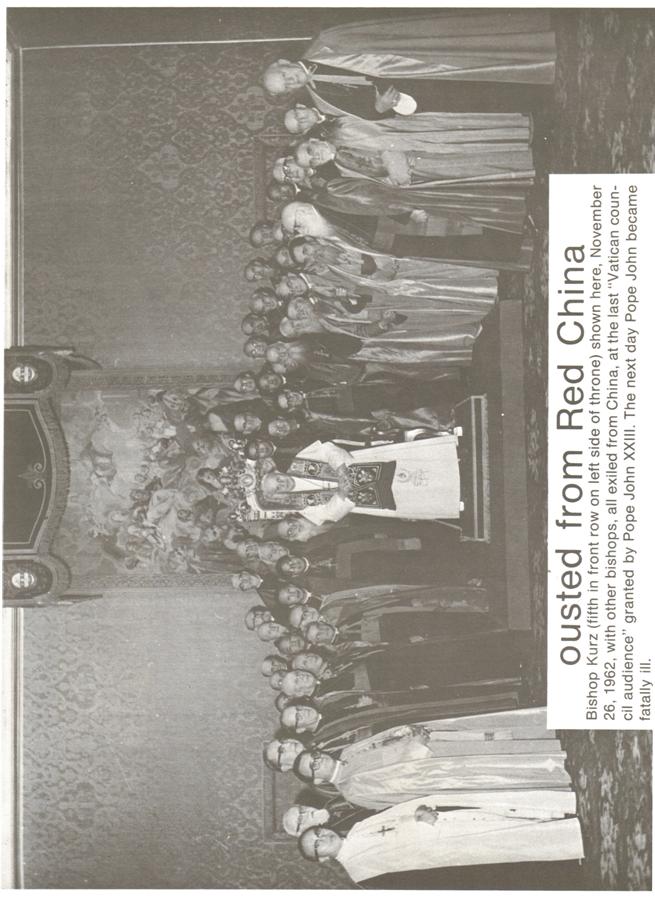
Kurz first assignment was as a Franciscan missionary in China. He labored very
hard as a missionary and his exemplary and at times heroic conduct was noticed
in Rome. In 1939 on the feast of Christ the King, in St. Peter’s Basilica, he
was consecrated a bishop of God’s Church by Pope Pius XII himself. No question
about Apostolic line of succession in this case. He received the title of
Titular Bishop of Terenuti. With his consecration as bishop, came a transfer
from his missionary work in China. Because he was unable to stay in his own
diocese in Germany during the war and recognizing his abilities from his
missionary work in China, the Holy See transferred him to the Diocese of
Kokstad, South Africa where they needed a bishop with the capabilities that
Bishop Kurz possessed. Kokstad is a small, but picturesque town on the slopes
of the Drakensberg Mountains, in the province of KwaZulu-Natal overlooking
South Africa’s southern coast. It is in this town of Kokstad, where the first
contacts between the DePauw’s and Bishop Kurz took place. At this time Fr.
DePauw’s brother, Fr. Adhemar, a Franciscan missionary in the Belgian Congo,
became ill with an ear problem which threaten to make him deaf. His doctor at
the mission told him that in order to recover from this ailment he needed to go
to a better climate in the south. He was sent to Johannesburg initially and
from there onto Kokstad.
When
WWII broke out, the Protestant British military authorities in South Africa
placed the Roman Catholic Bishop Kurz, a German citizen at the time, under
arrest. It was only through the intervention and the posting of bail by Fr.
Adhemar who at the time was a young Catholic Belgian Lieutenant, serving in the
British African Corps that Bishop Kurz was returned to freedom.
The
bishop was to spend eight years in Kokstad, living in a large institute for the
deaf and mute, until he was asked by Pius XII to return to China where he had
spent his first twenty years as a missionary. This was a very dangerous time in
China since the country was coming closer and closer to falling under Communist
domination. At the height of his spiritual and physical strength at the age of
54, Bishop Kurz accepted the Pope’s wish as an order and returned to Yungchow,
China. On May 21, 1948 he was appointed Prefect-Apostolic of Yungchow. The
bishop’s work there was both delicate and dangerous with the onslaught of the
Communists.
This
assignment was not to last as long as his first assignment in China. In 1949
the Communists were successful in taking over the complete mainland of China.
With that takeover they began a brutal suppression of the Church. Many
missionaries and bishops were imprisoned, tortured and killed.
Pope
Pius XII, personally ordered Bishop Kurz to return to Rome but he wanted to
stay with his Catholic flock even if it meant facing prison and even death. He
wanted to be among those the Pope would later call; “the most valiant witnesses
of Christ.” However, following the Pope’s order, he returned to Rome with the
hope of some day returning to the land of his early apostolate. That exile was
to last 24 years and his hope of one day returning to China was laid to rest
with his mortal remains.
For
the next several months Bishop Kurz resided in Rome. During this time the case
of Bishop Kurz came to the attention of Cardinal Spellman who had a special
soft spot in his heart for the victims of Communist persecution. He extended
the hospitality of his archdiocese and of the United States of America to the
Bishop. And so in the latter part of 1949, Bishop Kurz sailed to New York.
It
is quite the coincidence that Fr. DePauw and Bishop Kurz both came to the
United States only months apart in the same year and also both at the invitation
of Cardinal Spellman. They were to meet for the first time through Fr. Adhemar
shortly after arriving in this country. The first mention of Bishop Kurz in
Fr. DePauw’s diary was his first meeting with him on November 16th,
1950.
Over
the next two years, they would meet several times both in New York and
Washington D.C. where in 1951 and 1952 Father served as assistant in the parish
of The Immaculate Conception, while attending Catholic University.
Between
1949 and 1962, except for the an occasional Confirmation or Ordination ceremony
in various dioceses throughout New York State and in Puerto Rico, Bishop Kurz
performed the daily spiritual and other chores of a simple parish priest both
in the Bronx and in Staten Island boroughs of New York City. Despite being the
invited guest of the Cardinal of New York, the way Bishop Kurz was treated
during those years by some pastors in some rectories was shameful. He spent
most of his time in the parish of St. Mary’s of the Assumption in Port Richmond
where the room he was given was described by Fr. De Pauw as no bigger then a
broom closet.
There
are numerous references in Fr. DePauw’s diary of having been with Bishop Kurz
at various religious ceremonies and receptions during these years. But a
closer relationship between the two did not develop until the Council years. As
already published in our special newsletter for the 50th Anniversary
of the opening of the Second Vatican Council, it was Bishop Kurz who invited
Fr. DePauw to attend the Council with him as his personal expert and procurator
in July of 1962. Unlike many of the American hierarchy who during the Council
stayed at the finest and most luxurious hotels that Rome had to offer, they
both stayed at Villa Maria Regina, which at that time was a guest house of the
Sisters of Notre Dame in Rome.
Throughout
the Council, even at the sessions which Fr. DePauw was not permitted to attend
by the rector of the seminary in Emmitsburg, Bishop Kurz depended on Fr.
DePauw’s expertise and advice on the various proposals which were put before
the Council attendees. In the Fall of 1964, in gratitude for Fr. De Pauw’s
Council work as his “peritus personalis” ,Bishop Kurz requested from Cardinal
Shehan his Nihil Obstat to have Father made a monsignor. He asked it as a
personal favor from one bishop to another on the occasion of the Silver Jubilee
of his Episcopal consecration. But Cardinal Shehan refused to give it to
Bishop Kurz and even though the paperwork was already signed in Rome by the
Secretariat of State Cardinal Ameleto Cicognani, it was withdrawn. Instead,
Father received the Silver Medal of the Pontificate of Pope Paul VI. Bishop
Kurz was very upset about this and took it as a personal insult to him as a
bishop. He told Fr. De Pauw that the Silver Medal was a consolation on the part
of the Holy Father and Cardinal Cicognani, as a reaction to the Baltimore
archbishop’s refusal. There is much more to the story of Father’s being made a
monsignor which is a story of dishonesty and an attempted case of failed
chantage against Fr. De Pauw by the Cardinal of Baltimore. It basically came
down to this; domestic prelate in exchange for giving up the C.T.M. This was
made clear to Fr. De Pauw in a letter from the Bishop in February 1965. This
would be the opening salvo on the part of the Cardinal of Baltimore in trying
to silence Fr. De Pauw. Father would have none of it and chose honesty of
conscience over the monsignorship.
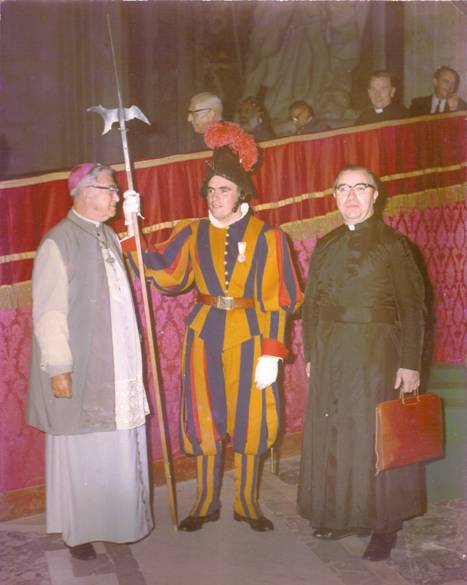
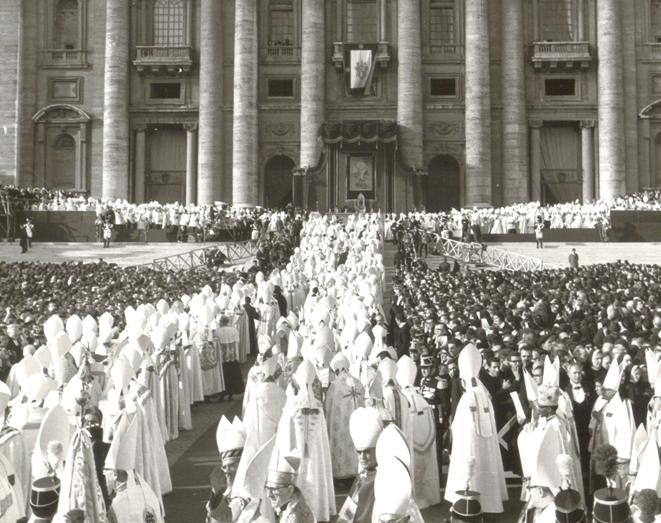
Bishop Kurz and Fr. De Pauw at the Council
On
December 31, 1964, Fr. DePauw sent the Catholic Traditionalist Manifesto, the
constitution of what three months later would become the Catholic
Traditionalist Movement, to all Catholic bishops throughout the world. Bishop
Kurz was first along with Cardinals Spellman and Ottaviani to give his blessing
and good wishes to what was to become a rough and tough fight for Truth and
Tradition. And while many Johnny-come-latelies now try to rewrite history and
portray others as the saviors of the True Catholic Faith, they were nowhere in
sight in 1964.
In
the Summer of 1965 Father was fired from the Seminary in Baltimore without
cause as another attempt by Cardinal Shehan to try and silence Father. In a
letter dated July 26th, the Cardinal ordered him to disassociate
himself from the C.T.M. and assigned him as an assistant priest in a parish in
Baltimore effective September 4th, “for the good of the Church in
the Archdiocese of Baltimore. This was clearly an act of punishment against
Fr. De Pauw for his involvement with the C.T.M. since only a few months before
the Cardinal had written Father telling him that his reputation among the
faculty and students of Mount St. Mary’s was “excellent.”. Father refused to
accept this firing since he had been hired to teach at Mount St. Mary’s by an
independent corporation, the Mount St. Mary’s Corporation, over which the
Diocese of Baltimore had no control and therefore he contended only that
corporation could fire him. Cardinal Shehan advised Father to either follow
his order or get out of the Baltimore Diocese.
Once
again Bishop Kurz would step in. At the suggestion of Cardinal Spellman, he
agreed to incardinate Father into his diocese of Yungchow and then immediately
make him his personal secretary. Bishop Kurz informed Cardinal Shehan of this,
but the Cardinal refused to agree to this, stating that Fr. De Pauw must ask
for the excardination himself. When this was done immediately, the Cardinal
still refused the excardination on the grounds that Bishop Kurz’ diocese held
no territory and that the Holy See would consider this a case of “quasi in
fraudem legis”.
The
Cardinal, in his refusal even went so far as to doubt the very existence of the
Diocese of Yungchow because of the Communist take over on mainland China. This
opinion was most definitely not held by the Holy See since the Holy Office had
ruled on this exact point in March of 1954 . At that time it stated that unless
an Apostolic Administration was appointed to fill the see, the exiled bishops
“preserve their jurisdiction except those who through special document from the
Holy See have been relieved of their see.” In the case of Bishop Kurz neither
of these exceptions applied. As a result his episcopal jurisdiction was never
suspended either by Canon Law or by the Holy See.
Bishop
Kurz was not only insulted by this answer from the Cardinal but was very upset
at the way the Cardinal was treating Fr. De Pauw. It is important to note that
while Cardinal Shehan was speaking for the Holy See, something he had no
jurisdiction to do, members of the Curia, besides Cardinal Spellman, holding
the highest positions in the Holy See, were telling Fr. De Pauw the exact
opposite. In fact in one case, he was told that the approval of the Cardinal of
Baltimore was not even needed for the incardination into Yungchow!
In
October of 1965 when the last sessions of the Council were opening Fr. De Pauw
went to the office of the Secretary General of the Council to renew his
credentials. He was told “the Secretary General refuses to accept you as
procurator.” When Father pressed the monsignor in charge at the time named
Luppi, whether or not Archbishop Pericle Felici, who was the Secretary General
of the Council, had actually said that, the monsignor then tried to make it
appear that this was the rule. Father was told that he must have a Nihil Obstat
from his ordinary before this could be done. However there was no such
requirement in Canon Law and no such ruling had been made or ever existed. This
“rule” had been fabricated as the result of a conversation between Cardinal
Shehan and Archbishop Felici. Bishop Kurz went to the office of the Secretary
General to speak to Archbishop Felici personally as to why his “peritus
privatus” was being denied access to the Council. He was told that the
Archbishop was attending a commission session and he would be unable to see
him. Bishop Kurz walked out of the office stating to a stunned monsignor; “the
whole thing stinks to hell.”
Bishop
Kurz understood this move on the part of the Cardinal of Baltimore for what it
was and got another Bishop, Berthold Buhl from Germany, to request Father as
his procurator. At about the same time this was happening, Bishop Kurz stopped
receiving the “Council Digest” of the American bishops and had to get it from
another bishop. While Cardinal Shehan was doing everything he could to silence
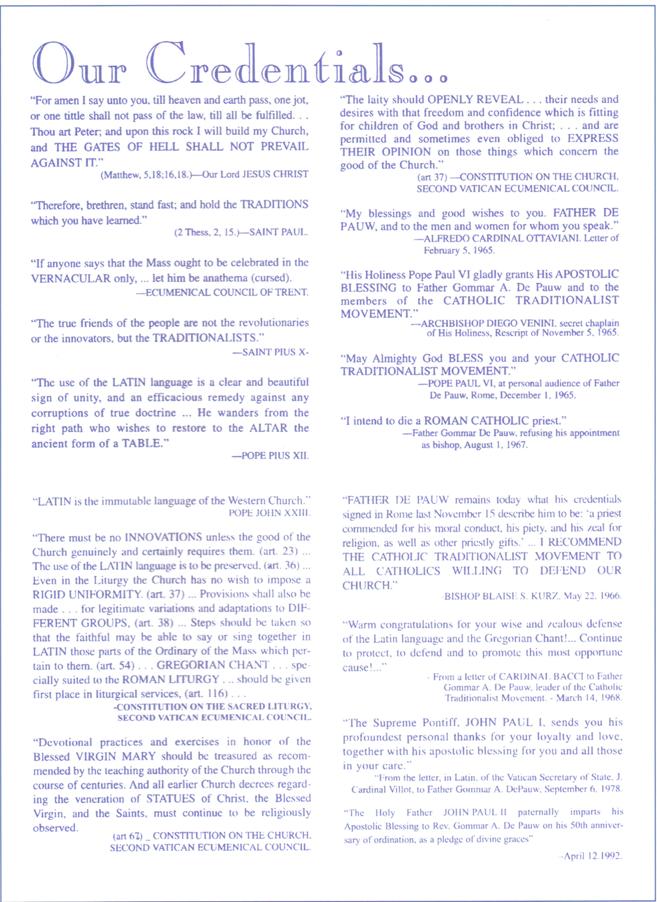
Fr. De Pauw, on November 5th, the Vatican issued a rescript with the
Apostolic Blessing of Pope Paul VI for the Catholic Traditionalist Movement,
signed by the secret chaplain of the Pope, Archbishop Diego Venini.
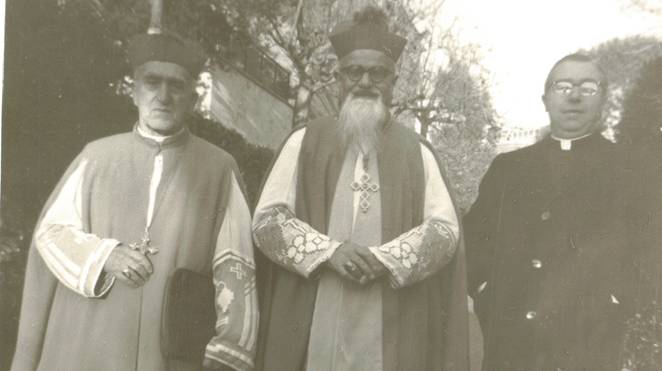
Bishop Berthold Buhl on the
left with Fr. De Pauw at the Villa Maria Regina
The bishop in the center is
another exiled bishop from China, Bishop Haring

Bishop Kurz with Fr. De Pauw at Mount St. Mary’s
Seminary
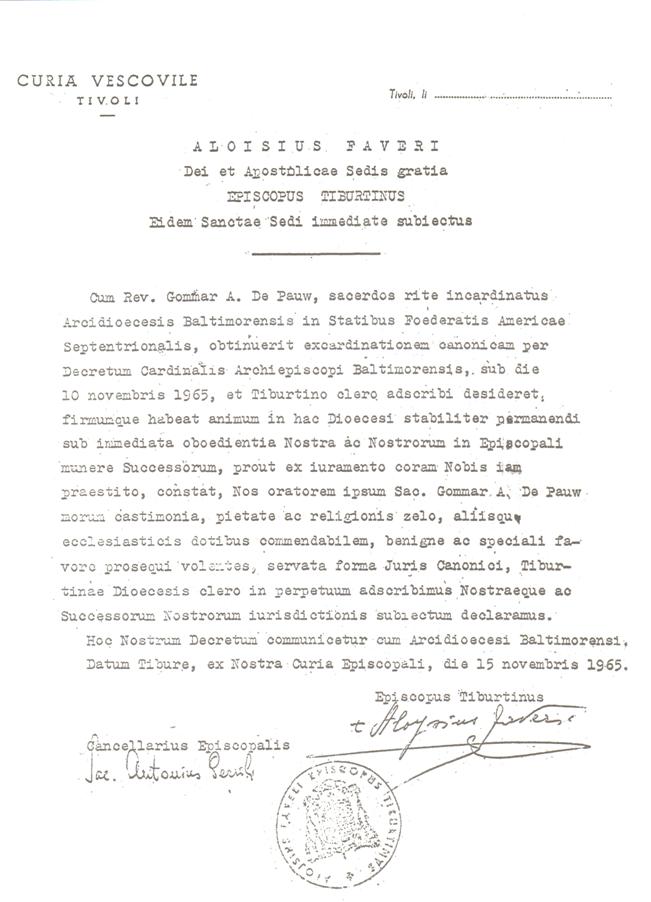
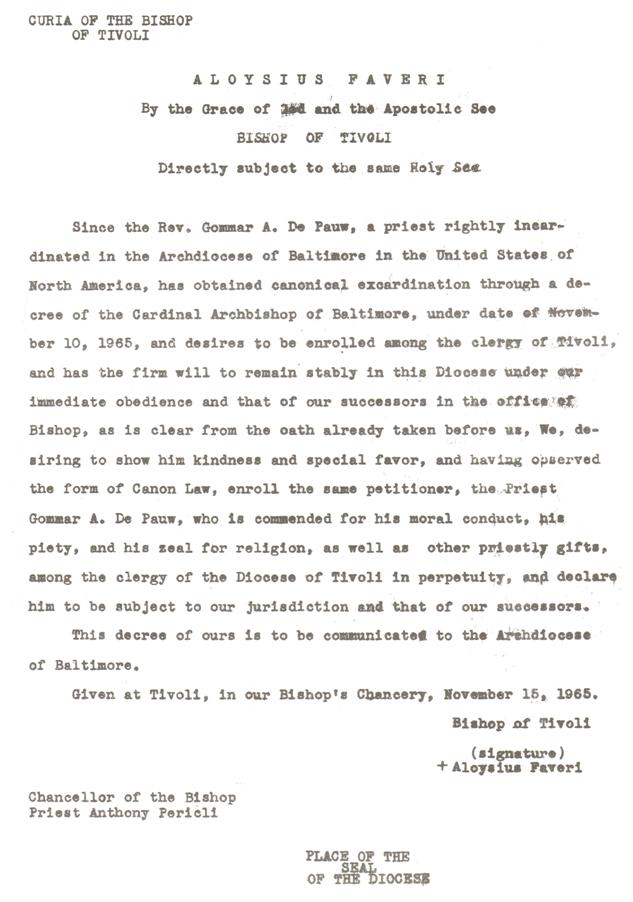
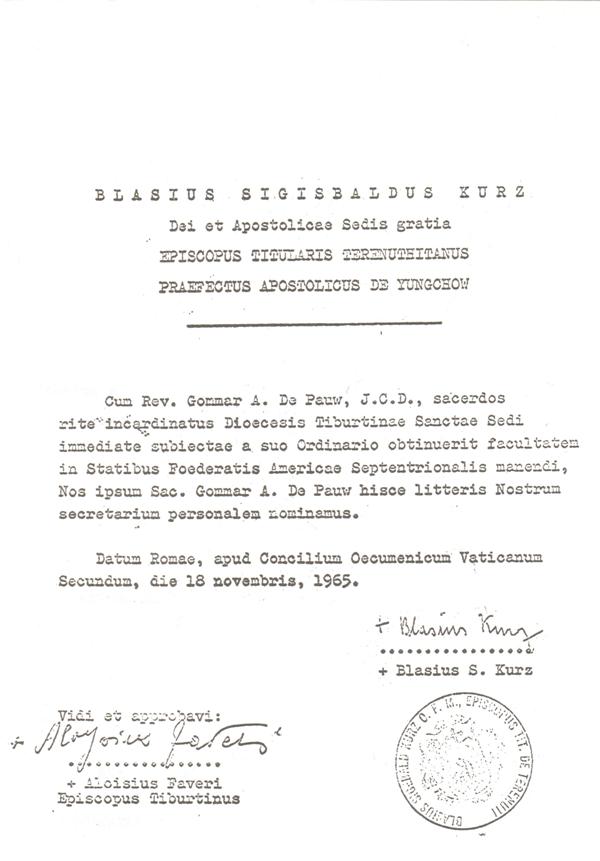
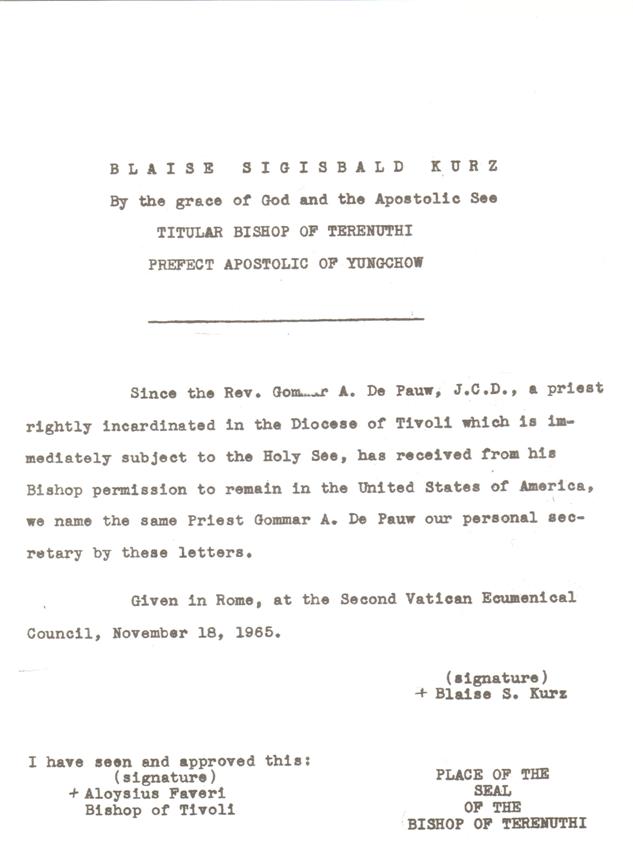
When
the excardination process of Fr. De Pauw to Tivoli was completed on November
15, 1965, Bishop Kurz immediately informed Bishop Faveri that he was making
Father his personal secretary to return with him to the United States when the
Council closed. Bishop Faveri immediately gave his approval for Father to leave
Tivoli for America since the purpose of this incardination had been made very
clear to him. Two days later on November 17th, Bishop Kurz wrote to
the Secretary of State Cardinal Cicognani and to Bishop Faveri renewing his
request to make Father a monsignor. On November 30th, Bishop Kurz
agreed to become publicly associated with the C.T.M. after learning that Archbishop
Lefebvre had declined to accept a position of leadership or to give public
support to any traditionalist groups then being organized in Europe or the
United States. The Archbishop had told this to Fr. De Pauw in a meeting between
the two in Paris on August 24th 1965.
A
year later when the news media all over the world headlined the open
credibility conflict between Fr. DePauw and the Cardinal Archbishop of
Baltimore, regarding Fr. DePauw’s excardination from Baltimore and incarnation
into Tivoli, it was only Bishop Kurz who stood alone in defending Fr. DePauw in
the public arena. Despite being involved “up to their eyeballs” in the
process, neither Cardinal Spellman nor Cardinal Ottaviani defended Fr. DePauw’s
reputation against one of their own in the cardinal’s club. Someday in the not
to distant future those details will be made public. The historical record will
be told to set those straight who said that neither Cardinal Spellman nor
Cardinal Ottaviani ever backed Fr. DePauw because they never came out publicly
and said so.
The
lack of public support on the part of both Cardinals Spellman and Ottaviani,
which the Bishop saw as cowardice, plus the “diabolical madness” as he called
it, of Cardinal Shehan, made him disgusted and he said he wanted to go before
the world’s media and reveal everything he knows. This was stated in a meeting
with Fr. De Pauw on January 15th, 1966. Fr. De Pauw urged him to be
restrained so as not to embarrass either Cardinal publicly. Two days later the
New York Times carried an exclusive story to their news organization datelined
from Rome, stating “Italian Bishop won’t accept De Pauw …situation is cloudy.”
Fr. De Pauw was unable to restrain the Bishop any longer and he demanded that
he wanted to put out a public statement. The original draft of the statement
was prepared by Father Adhemar, but was rejected by the Bishop as not strong
enough. Fr. De Pauw was able to convince him however, that too harsh a
statement would do more harm then good.
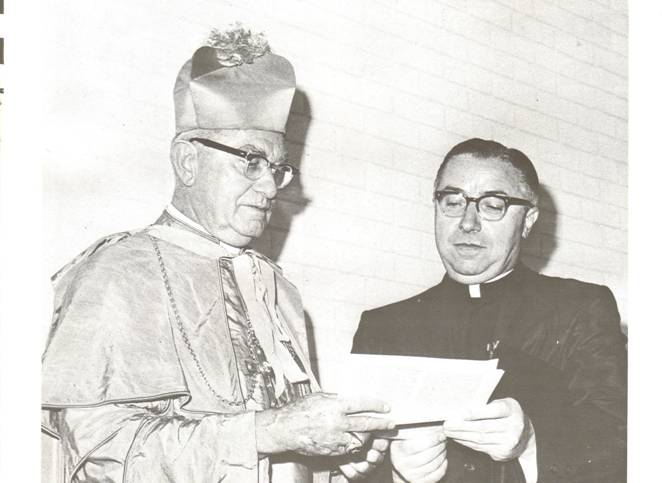
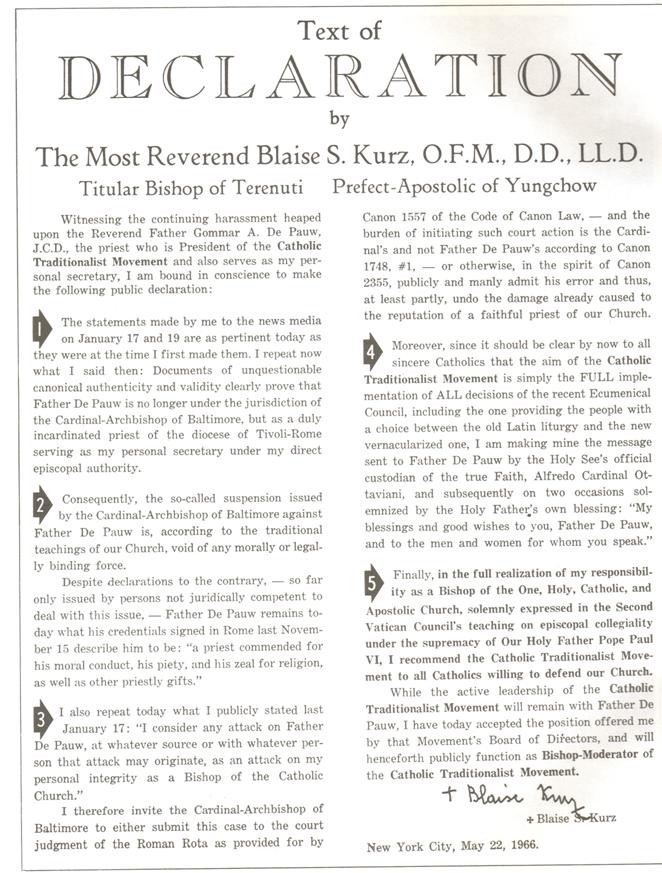
Bishop Kurz and Fr. De Pauw reviewing May 22nd
Declaration
announcing that he would become Bishop Moderator of
the C.T.M.
It
was then left to Bishop Kurz to set the record straight in the dispute with the
Cardinal of Baltimore and he did so by putting his personal integrity as a
bishop on the line. This was an act of unbelievable courage on the part of the
Bishop, to stake his own personal integrity as a bishop against that of a
Cardinal of the Church. But he did so believing how unjust and uncharitable as
well as how untruthful the Cardinal of Baltimore was being. Of course this was
not the first time Bishop Kurz had dealt with the untruthfulness of Cardinal
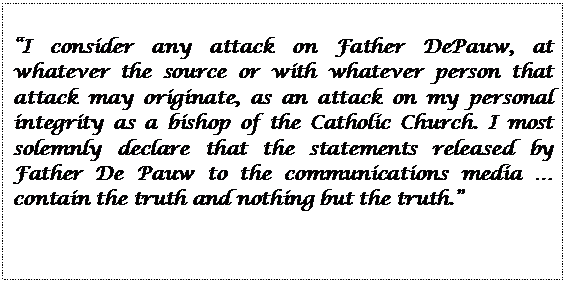
Shehan. And so on January 17th, 1966, he made the following public
declaration to the news media, the text of which had been previously sent
privately to Pope Paul VI.
After
this public backing of the C.T.M. leader, the Bishop was subjected to a
firestorm of unbelievable proportions by his fellow bishops here in America to
retract that statement and his now public backing of the Movement. On January
18th, 1966, Father received a telegram from Cardinal Shehan
informing him that the day before he had received a letter from the Apostolic
Delegate Vagnozzi stating that the Cardinal Secretary of State Cicognani had
informed him that Fr. De Pauw was still a priest of the Archdiocese of
Baltimore. He directed Father to come to his office on January 21st“to
receive instructions for the future.” In reaction to this ultimatum from
Cardinal Shehan, Bishop Kurz ordered Fr. De Pauw, his personal secretary, not
to report to Baltimore and to make a statement to the press to that effect.
The Bishop then sent a strongly worded letter to Cardinal Shehan informing him
of the same.
Very
heavy pressure was inflicted on the Bishop to retract his support. Rather than
retract his statement and support, the Bishop issued an even stronger public
statement. It was something Cardinal Spellman was too scared to do himself. It
was something which Cardinal Ottaviani did not do either. The Secretariat of
State, Cardinal Cicognani, threatened Bishop Kurz not to do it , even though
Cardinal Cicognani was well aware that Fr. DePauw’s version of the November 10th
to the 15th , 1965 events was in fact the truth. Bishop Kurz was
also threatened by the Apostolic Delgate Egidio Vagnozzi, not to make that
stronger public statement. Even though the Apostolic Delegate also knew that
Fr. De Pauw’s version of the November 10th to15th, 1965 events was in fact
true. He also was aware of the veiled retribution being directed at Fr. DePauw
by the seminary and the Diocese of Baltimore since sending the Manifesto to the
bishops. He had inquired in a meeting on January 14, 1965, with Fr. De Pauw
whether or not the seminary had fired him for it.
The
Apostolic Delegate at that same meeting had read and approved of the
Manifesto. He had offered to help rewrite parts of it to make it more
palatable to the bishops. He encouraged Father and told him “if they do
anything to you, appeal to Rome, and I will back you up.” After
encouraging Fr. De Pauw in 1964 and early 1965, he led the betrayal of him here
in the U.S. in late 1965 and 1966. In 1967, Egidio Vagnozzi receoved the
Cardinals hat, “coincidence” I don’t think so!
However,
no pressure from any source was to deter the Bishop so he reconfirmed his prior
January 17th statement on May 22nd, 1966 in the Garden
City Hotel on Long Island before a speech to be given by Fr. De Pauw before a
packed hall. The speech was delayed for some time because of the threats which
had been made against the Bishop by the Secretariat of State and the Apostolic
Delegate. But having survived and gone through all he had already in his
lifetime, he was not to be deterred and went ahead and not only reconfirmed his
January 17th statement but added as well the following:
In
the full realization of my responsibility as a bishop of the One, Holy,
Catholic, and Apostolic Church, solemnly expressed in the Second Vatican
Council’s teaching on Episcopal collegiality under the supremacy of our Holy
Father, Pope Paul VI, I recommend the Catholic Traditionalist Movement to
all Catholics willing to defend our church. While the active leadership of
the Catholic Traditionalist Movement will remain with Father De Pauw, I have
today accepted the position offered me by that Movement’s Board of Director’s,
and “will henceforth publicly function as Bishop Moderator of the Catholic
Traditionalist Movement.”
Despite
his recommending the C.T.M. to all bishops and to all priests as the God given
instrument to save their priesthood and their Church, NOT ONE bishop,
repeat, NOT ONE bishop was willing to take their place next to Bishop
Kurz or Fr. De Pauw. Not even Archbishop Lefebvre was willing to join them. NOT
ONE priest, not even among the some one hundred and sixty priests, who in
the greatest tradition of Nicodemus, had secretly joined the C.T.M., was
willing to stand next to the Bishop or Father publicly either.
So
disillusioned was Bishop Kurz by this fact that it led him to comment later, in
not so glowing terms, describing his fellow bishops and the priests as “dirty
rats who in 1966 for all times forfeited their right to ever open their mouths
as spokesmen for orthodox Roman Catholics.”
In
December of 1966, the Diocese of Baltimore triumphantly communicated to the
press a document signed by three so-called “consultors” of the Roman Curia’s
Congregation of the Council in which they gave their opinion that the 1965
transfer of Father from Baltimore to Tivoli was invalid. The document, dated
September 30th, was missing the signature of the Cardinal Prefector
any of that Congregation’s secretaries thereby rendering the document as
juridically non-existent and morally unjust. Fr. De Pauw had received this
document on October 22, 1966 and rejected it on these grounds. On October 25,
Father informed Archbishop Pietro Palazzini, who was the Secretary of the
Congregation of the Council of his rejection. Bishop Kurz followed that up
with a letter on December 7th, officially informing the Holy See
that both his and Fr. De Pauw’s position was unchanged. He stated that unless
the Supreme Pontiff personally or the Roman Rota rule differently, they would
continue to base their position on the official documents signed, counter
signed and sealed in Rome during November 1965. The official documents proved
that Fr. De Pauw was validly transferred from the jurisdiction of the
Archbishop of Baltimore to that of the Bishop of Tivoli-Rome who in turn
released Fr. De Pauw to serve as his personal secretary residing in New York
City.
The
death of Cardinal Spellman, in December of 1967 further disillusioned Bishop
Kurz since the Cardinal had been his official host and the behind the scenes
protector of the C.T.M. At the age of 73, the bishop was now in failing health
and decided he would return to Germany to see his long time doctor whom he
trusted. He also longed for the peace and serenity of his native Bavaria. Who
could blame him after the life he had. During this time Fr. De Pauw was looking
to open a chapel as a fully functioning Roman Catholic parish. He hoped that it
would be the model for similar chapels throughout the United States and in fact
throughout the world where traditionalist Roman Catholics could once again feel
at home in their churches.
Bishop
Kurz played an important role in the opening of the Ave Maria Chapel in
Westbury, New York and its establishment as the new headquarters of the
Catholic Traditionalist Movement which up until then had been in the Pan Am
building in New York City
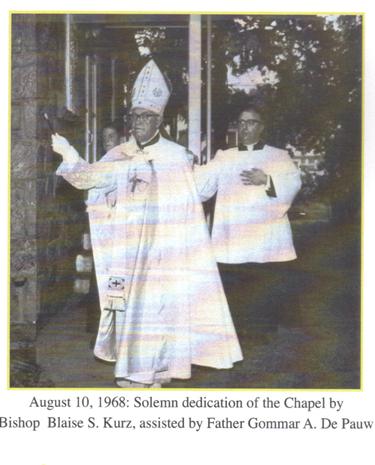
After
the Chapel was opened in June of 1968, the Bishop delayed his returned to
Germany in order to solemnly dedicate the Chapel on August 10, 1968. On that
same day he administered the Sacrament of Confirmation to 164 children of the
Chapel. Fr. De Pauw tried to convince him to stay in Westbury and offered him
fairly comfortable quarters. But the bishop had his heart set on returning to
Germany. He left with the solemn promise to continue to function as the
Moderator of the Catholic Traditionalist Movement. This was a promise which he
kept till his last day. He also promised to return to Westbury at regular
intervals to administer Confirmation to the children for as long as his health
permitted. He did so two more times on May 24, 1969, and again on October 18,
1970. He described those visits back to Westbury as the happiest days of his
latter years.
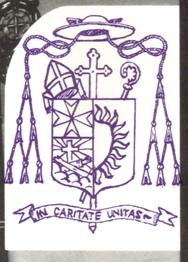
Coat of Arms of Bishop Kurz
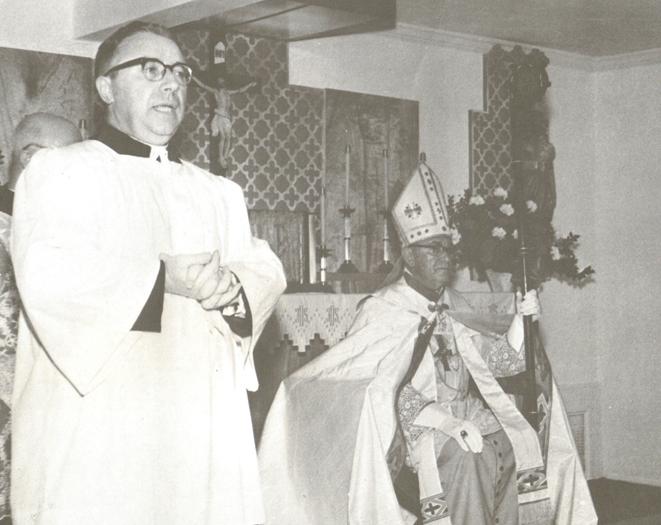
Fr. De Pauw welcoming Bishop
Kurz to the Ave Maria Chapel, August 10, 1968
Due
to illness the Confirmations which were planned for 1972 and 1973 had to be
cancelled. His health did not permit him to make the long trip from Germany to
Westbury. But he did not abandon the children in Westbury. He sought a
replacement for himself. He asked a fellow Franciscan Bishop, Jorge Pflaum from
Bolivia, to fill in for him and confirm in Westbury. The Bishop was one of
those conservative bishops which Fr. De Pauw knew very well from the Council
days. Bishop Pflaum had told Bishop Kurz he was willing stand in for him and to
confirm at the Chapel.
However,
Bishop Pflaum reneged on his promise to Bishop Kurz and refused to confirm. All
efforts by Fr. De Pauw to contact him failed. Instead of contacting Fr. De Pauw
to set the date for Confirmation, he boarded a plane to Bolivia without so much
as a word to either Fr. De Pauw or Bishop Kurz.
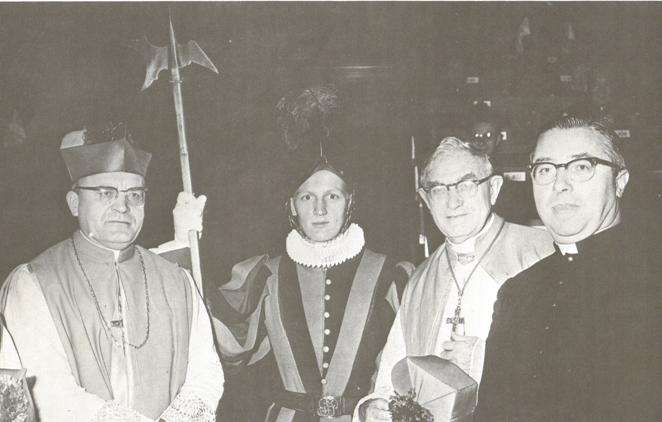
Bishop Jorge Pflaum of
Concepcion, Bolivia with Bishop Kurz and Fr. De Pauw
After
this disappointing episode, Fr. De Pauw wrote to French Archbishop Marcel
Lefebvre in April of 1973 asking him to fill in for Bishop Kurz. The answer
Father received, April 12th,1973, Father’s ordination anniversary,
read as follows:
“As
far as confirmation is concerned, it is clear that this is a very delicate
thing for me to do…I have to be very prudent in this area.”
Archbishop
Lefebvre told Fr. De Pauw he would prefer to discuss this in person and told
him he was planning to come to the United States in the summer of 1973. However
the Archbishop did not make that trip. In the spring of 1974 after the death
of Bishop Kurz, Father learned that the Archbishop was once again planning a
trip to the United States and he wrote to him in April of that year renewing
his invitation to administer Confirmation to some 200 children. As with the
last invitation, Father offered to pay for all his travel and accommodation
expenses. The reply in a letter dated April 29, 1974 was:
“I
must confess that I am still not quite certain of going there, and that I
probably will postpone this trip till later, perhaps during the month of
November.”
By
the time Archbishop Lefebvre did come to the U.S. in the Fall of 1974, he was
in open rebellion against the Pope. Father had also subsequently learned that
when Archbishop Lefebvre cancelled a planned meeting with him in New York City
in the summer of 1971, the Archbishop had indeed flown to the United States and
met with several American bishops and entered into an accord, to if not
publicly fight the C.T.M., then to at least ignore it and its leader. In the
Fall of 1974, Father received a communication from someone representing the
Archbishop inviting Father to bring the children of the Chapel to a nearby
hotel to receive Confirmation from the Archbishop.
Despite
the clear efforts of the Archbishop to sabotage the C.T.M., for the good of the
children of the Ave Maria Chapel, Father considered accepting this offer and
sought the advice of Cardinal Ottaviani, the Apostolic Delegate Jean Jadot and
Bishop DeKesel. In all three cases Father was told to have nothing to do with
the planned Confimation by the Archbishop.
In
November of 1970, Bishop Kurz did ordain one priest not connected with the
C.T.M. It was at the request of Archbishop Lefebvre who told Bishop Kurz he
did not have the jurisdiction to do so himself. The Archbishop had told Bishop
Kurz that he would attend the Ordination but never showed up. In his report to
Fr. De Pauw after the ordination he told Father that Archbishop Lefebvre had a
seminary near Fribourg, Switzerland and that six of the seminarians from that
seminary came to the ordination ceremony. He told Father that Archbishop
Lefebvre was planning on forming a new congregation in order to ordain the
young men. He also told Father that because the Archbishop is“persona
ingratissima in Rome” he assumes that he will be asked to perform further
ordinations. He also told Father that before the ordination he received a
letter from the Archbishop expressing his pleasure that there are still some
Catholic Bishops left. Not long after that ordination the Bishop received a
letter from the new Apostolic Delegate in Washington, Liugi Raimondi, inquiring
about the ordination. He requested to know the name of the priest, and who his
ordinary was and the canonical title of ordination. The Bishop had performed
the ordination “sub titulo missionis” , for his mission in China since he was
still the Prefect Apostolic of Yungchow. When the Bishop advised Fr. De Pauw
that he planned to ordain another seminarian who was of late vocation, Fr. De
Pauw advised him not to do so as Father suspected a canonical trap was being
laid for the Bishop in light of the letter from the Apostolic Delegate.
During
the time of 1972 and 1973, the Bishop was once again subjected to heavy
pressure from what he described as “some characters” in Rome and in Germany, to
fall in line with the rest of the bishops. Fr. De Pauw advised Bishop Kurz that
he should return to the United States and to Westbury where he could live out
the remainder of his life in the company of friends who would show him the
respect he deserved. The Bishop was convinced and decided that he would return
as soon as his health permitted him to travel. In the meantime, Fr. De Pauw
set about building a new rectory for him on the recently acquired property
across the street from the Chapel.
In
November of 1973, the Bishop informed Fr. De Pauw that his health had improved
enough for him to make the trip to Westbury and to set a date for the next
Confirmation as soon as the new rectory was completed. Its completion was
expected in May of 1974. Bishop Kurz himself selected, Easter Sunday of 1974
as the date that Fr. De Pauw should announce to the people his decision to
permanently return to Westbury where he planned to spend the last years of his
life at, as he described it, “the only place in the world where the true Faith
has never died.”
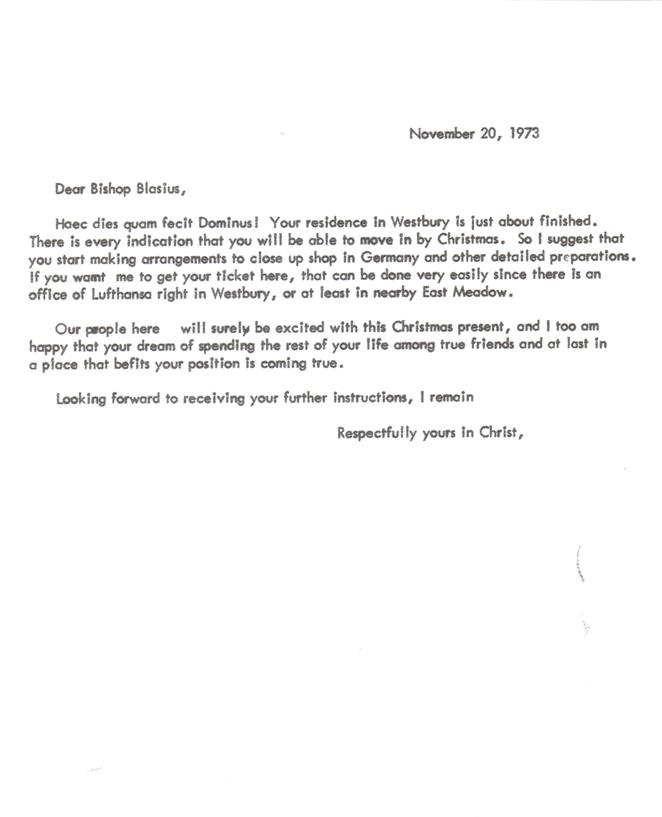
Work
on the new rectory however was nearing completion in November of 1973 and on
November 20th, Father wrote to the Bishop informing him of this
telling him he would be able to move into it by Christmas. He told him to start
making the arrangements and offered to get his plane ticket.
That
November 20th letter was the last communication of Fr. De Pauw to
Bishop Kurz and was left unanswered. Instead of receiving a reply from him, a
month later Father received, word that the Bishop had died on December 13th.
The date he received this information was December 19th, the same
day the Bishop was buried. Thus, Fr. De Pauw was prevented from attending and
conducting his funeral but even more so, from burying his mortal remains on
Long Island in the nearby Pinelawn Cemetery, in a plot Father had personally
purchased for him and where he would forever be among his C.T.M. people.
Instead,
he was buried in the cemetery of the Franciscan seminary of Neurenberg,
Germany, where he had been ordained to the priesthood 54 years earlier almost
to the exact day. He was buried in a grave with some 20 other Franciscan
missionaries with the simple epitaph of “Missionary Bishop of China”. No
mention of his 54 years of service and suffering for the Church, and of course
to be expected, no mention of his defense of the True Faith and Church as
Moderator of the Catholic Traditionalist Movement. In October, 2011, current
President of the Catholic Traditionalist Movement, Richard Cuneo, flew to Germany
to visit the grave of Bishop Kurz in anticipation of the upcoming 40th
anniversary of his death. It was the first time any member of the Catholic
Traditionalist Movement had visited his grave.
His
death was a significant loss to the C.T.M. and to Fr. De Pauw personally whom
he described in his statement to the news media on December 30, 1973, as “a
respected father and a personal friend”. This did not change any policy or
operation where the Movement was concerned and did not change the Ave Maria Chapel.
Since
the Bishop’s death in 1973, those on the right have sought to marginalize
Bishop Kurz. They sarcastically ask how many priests he ordained to carry on
the fight for Truth and Tradition. How many bishops did he consecrate to keep
alive the Apostolic succession which he received directly from Pope Pius XII?
Some even claim they never heard of him.
Well,
it is our job to set the historical record straight. And that historical record
shows that if it were not for Bishop Kurz, Father never would have been able to
accomplish what he did. The historical record also shows that in those critical
early days of raising the flag of resistance to those who sought to destroy our
Church, Bishop Kurz was critical to that effort. Were it not for his critical
Episcopal role, while it would not have altered Fr. De Pauw’s course, it
certainly would not have been as effective and certainly more difficult. His
courage and Episcopal authority was essential especially in the public forum.
In conjunction with the behind the scenes authority of Cardinal’s Spellman and
Ottaviani, he was able to effectively counter every effort on the part of
Cardinal Shehan to silence Fr. De Pauw and stop the Catholic Traditionalist
Movement.
The
historical record shows that his part was crucial to the success of the
Catholic Traditionalist Movement to become an effective voice in the fight for
Truth and Tradition and he did so without leading those people in his charge
into schism.
And
so the Catholic Traditionalist Movement remembers him grate-fully for his
crucial role in the fight for Truth and Tradition when NO ONE ELSE DARED TO
DO SO!
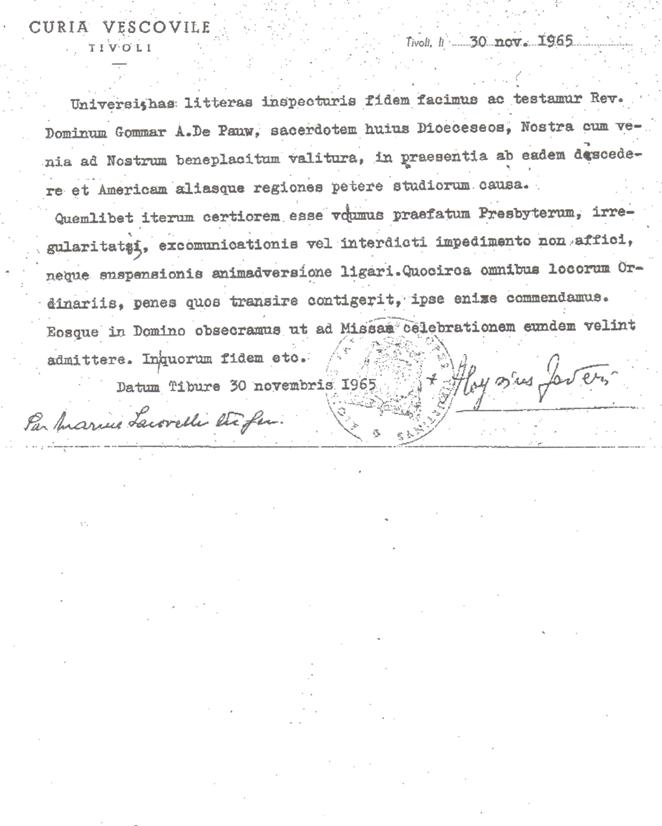
CURIA VESCOVILLE
Tivoli, Italy Nov.30 1965
TIVOLI
After a thorough examination
of your letter, we certify that Reverend Father Gommar A.
De Pauw, a priest of this
diocese, with our permission and with our pleasure presently
will leave this diocese
because he will travel to other places in America and in other
countries to continue his
studies.
We also certify that for the
abovementioned priest there exists no impediment whatsoever
of irregularity,
excommunication or interdict, and that he is not restricted by any
suspension.
We also earnestly recommend
him to all the bishops and superiors of all the places he
will visit or stay. We also
ask them to give him the permission to celebrate Mass in their
diocese. To the truth of
these statements etc…..
Issued
in Tivoli, November 30 1965
+Aloysius
Faveri
By Marius Iacovelli Vicar
General
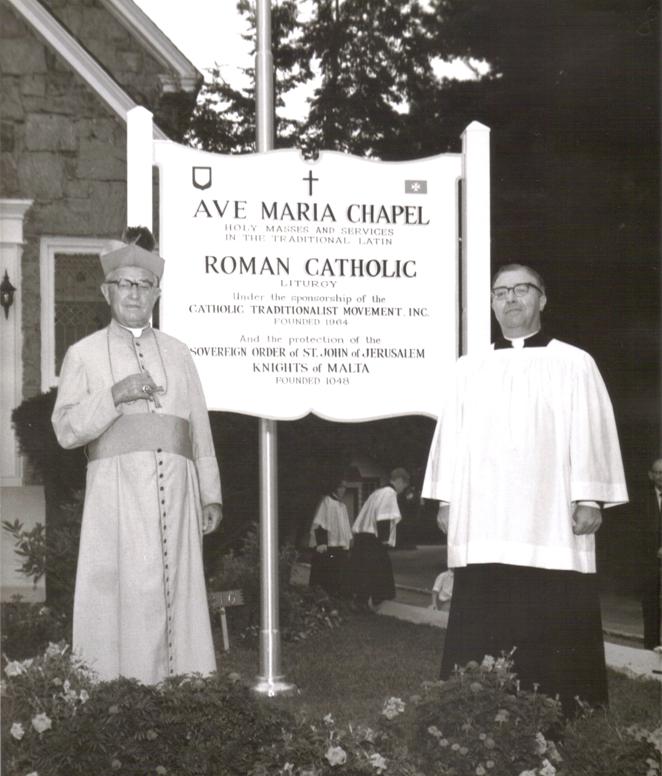
Bishop Kurz and Fr. De Pauw in front of the Ave Maria
Chapel
August 10, 1968
|
